Wasserstein-Barycentric Interaction Fields for Spatial Factor Models: Evidence from Language-Model Representations
Target-anchored transport and simplex reconstruction turn distributions of firm information into a directed, bandwidth-free peer field for spatial exposure adjustment.
Abstract
Spatial return models usually begin with an interaction matrix supplied by the researcher. This paper instead constructs a bandwidth-free field from firms' language-model article-embedding distributions. For each target firm, quadratic transport aligns its article cloud separately with every candidate peer. Holding those target-specific correspondences fixed, a simplex problem chooses nonnegative, unit-sum weights that jointly reconstruct the target.
Repeating the reconstruction across targets produces a directed barycentric interaction field. A quadratic exposure-adjustment problem then maps spatial feedback into the relative penalty placed on peer misalignment versus departure from a stand-alone exposure.
Reading the field
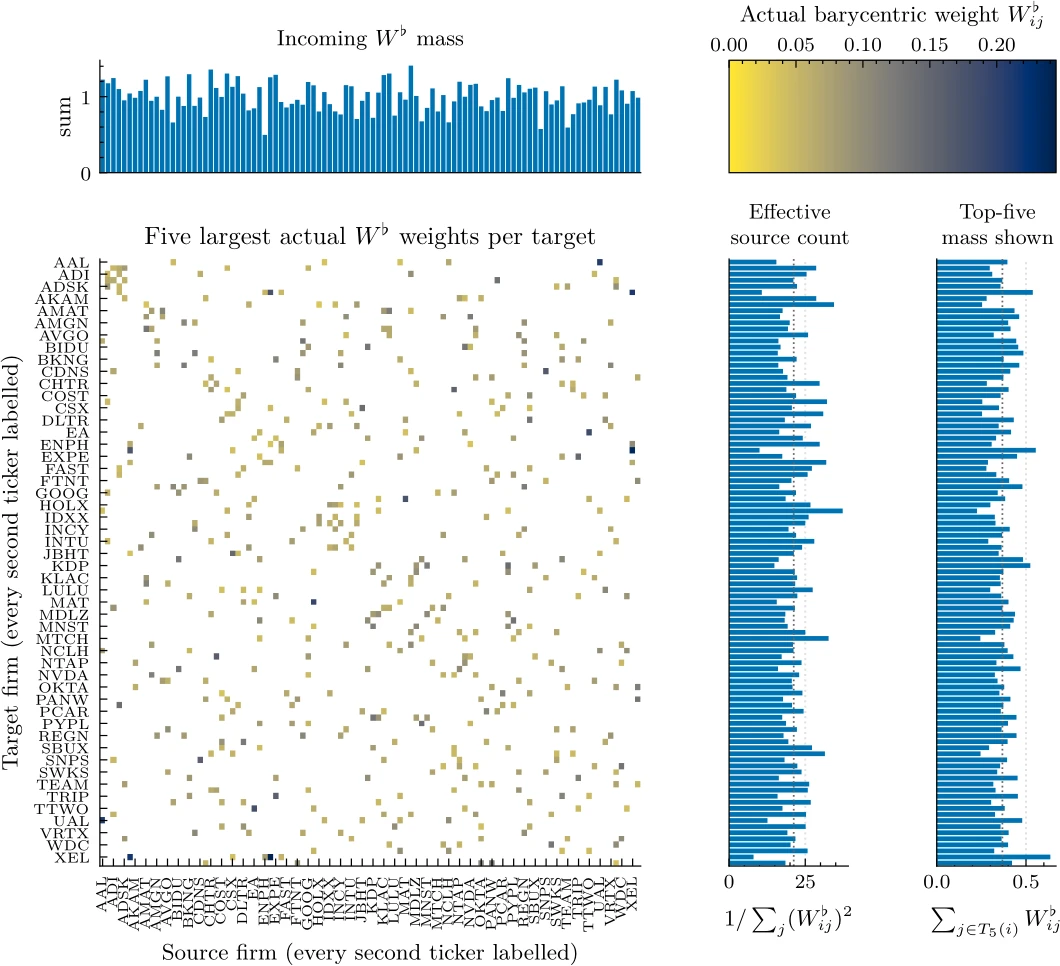
The heat map is most useful when read one target row at a time. The fitted field is heterogeneous in both directions: targets draw on different peer mixes, and some source firms receive more total incoming weight than others. Figure 2 shows the five largest actual weights in each target row, alongside incoming mass, effective source count, and the share of each complete row captured by the displayed top five.
AMD provides a particularly legible economic example. Its five largest sources are NVDA (0.133), INTC (0.108), AMAT (0.105), MU (0.101), and LRCX (0.061), together carrying 0.508 of AMD's unit row. This is a recognizable semiconductor ecosystem spanning accelerator and processor design, memory, and equipment supply. The pattern is economically suggestive of shared technology and supply-chain language. It is not a claim that these firms are direct substitutes, that AMD owns them, or that the coefficients are portfolio weights.
AMD's effective source count is 14.4, below the cross-target median of 18.3, so its information footprint is more concentrated than a typical target's. Even here, the five highlighted cells show only about half of the row. The remaining positive coefficients are still part of the field, which is why a vivid cell should be read as a leading coordinate rather than a complete explanation.
The scattered, row-specific cells are the expected signature of target-anchored reconstruction rather than a symmetric distance map. The upper incoming-mass bars answer a different question from the AMD row: they show which sources are repeatedly useful across targets. In the complete field, CSCO, LRCX, EXPE, AVGO, QCOM, and INTC are among the largest receivers. The effective-source-count bars use every coefficient in each row, while top-five mass measures only how much of that full row is visible in the heat map. White cells therefore mean unshown or zero coefficients, not necessarily that a source is irrelevant.
These visual relationships suggest a useful economic follow-up: when a target draws on a recognizable ecosystem, does the mixture reflect common technology, customers, suppliers, or investor attention? The field can organize that investigation, but it does not establish causal peer influence or return substitutability.
Mathematical sequence
- Represent each firm by an equally weighted empirical distribution of article embeddings.
- Solve one target-to-peer optimal-transport assignment for every ordered pair.
- Freeze those correspondences and reconstruct the target with one common set of simplex weights.
- Stack the target-specific rows into a nonnegative, row-stochastic, zero-diagonal operator.
- Derive the exposure equation
B = ρWB + (1 − ρ)ξ, with ρ = λ / (1 + λ).
Why the field is directed
Quadratic Wasserstein distance is symmetric, but representational usefulness is target-specific. Firm j can receive a large weight when reconstructing firm i even when firm i is not equally useful for reconstructing firm j. Direction therefore records reconstruction relevance, not an asymmetric distance and not causal influence.