
Skip to content
Marcus Gawronsky

Research made operational.

Quantitative research · Applied AI · Research engineering

Marcus Gawronsky is a researcher and technical founder in Cape Town, building AI systems, testing their impact and developing new ways to measure financial risk.

01 /

The work

From questions to evidence

Ideas become useful through precise models, empirical tests and reliable software.

Can an interesting idea become rigorous enough to defend and robust enough to use?
Quantitative research
Making relationships measurable: how firms interact, share risk and respond to changing opportunities.
Research engineering
Connecting data, assumptions and software so results can be reproduced, inspected and challenged.
Applied AI
Building multimodal search and recommendations, then testing their impact through real-world experiments.
Galton board simulationForty balls make ten independent left or right choices and accumulate by number of right turns. Outlined bars show the expected binomial counts; the normal approximation appears after the final ball lands.40 trialsn = 10 · p = ½012345678910
Number of right turns
40-ball sample
Galton boardIndependent choices → binomial paths → a normal law
Question
How do coin flips become a bell curve?
Observation
Simple random processes produce predictable structure. Simulation lets us see why.
02 /

Selected work

Research, systems, and tools

Each project pairs a research question with the computational machinery needed to test it, reproduce it, and carry it forward.

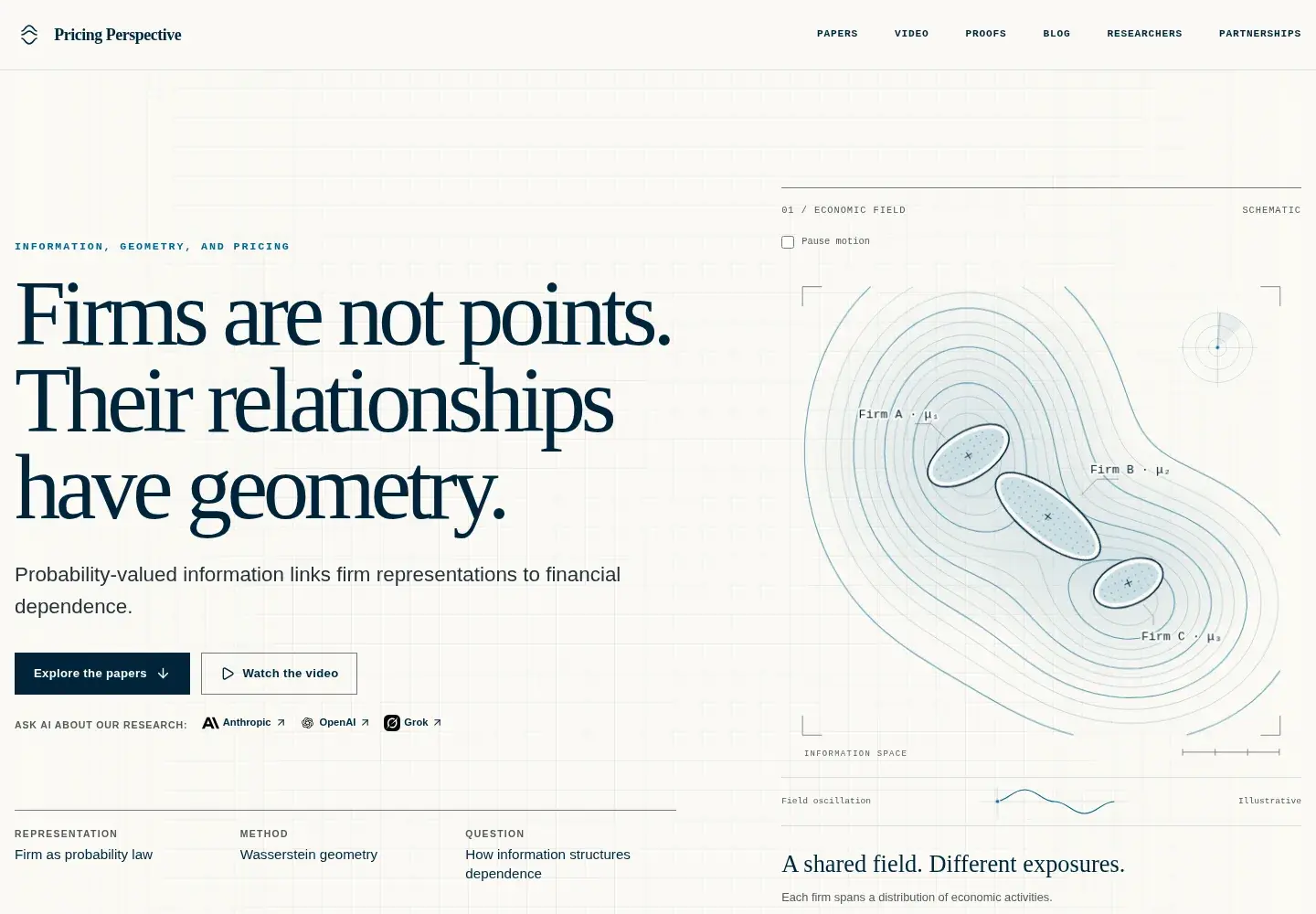
Pricing Perspective homepage with deep-ocean navigation and a hydrographic field illustration.
Website preview · Pricing Perspective

Pricing Perspective

Can company information reveal economic relationships and financial risk?

A quantitative-finance research programme connecting language-model representations, optimal transport and portfolio risk, with software for empirical tests, simulation and formal verification.

Methods: Optimal transport and Wasserstein geometry · Covariance and factor structure · Language-model representations · Reproducible research systems

Python · Lean 4 · LaTeX · Next.js
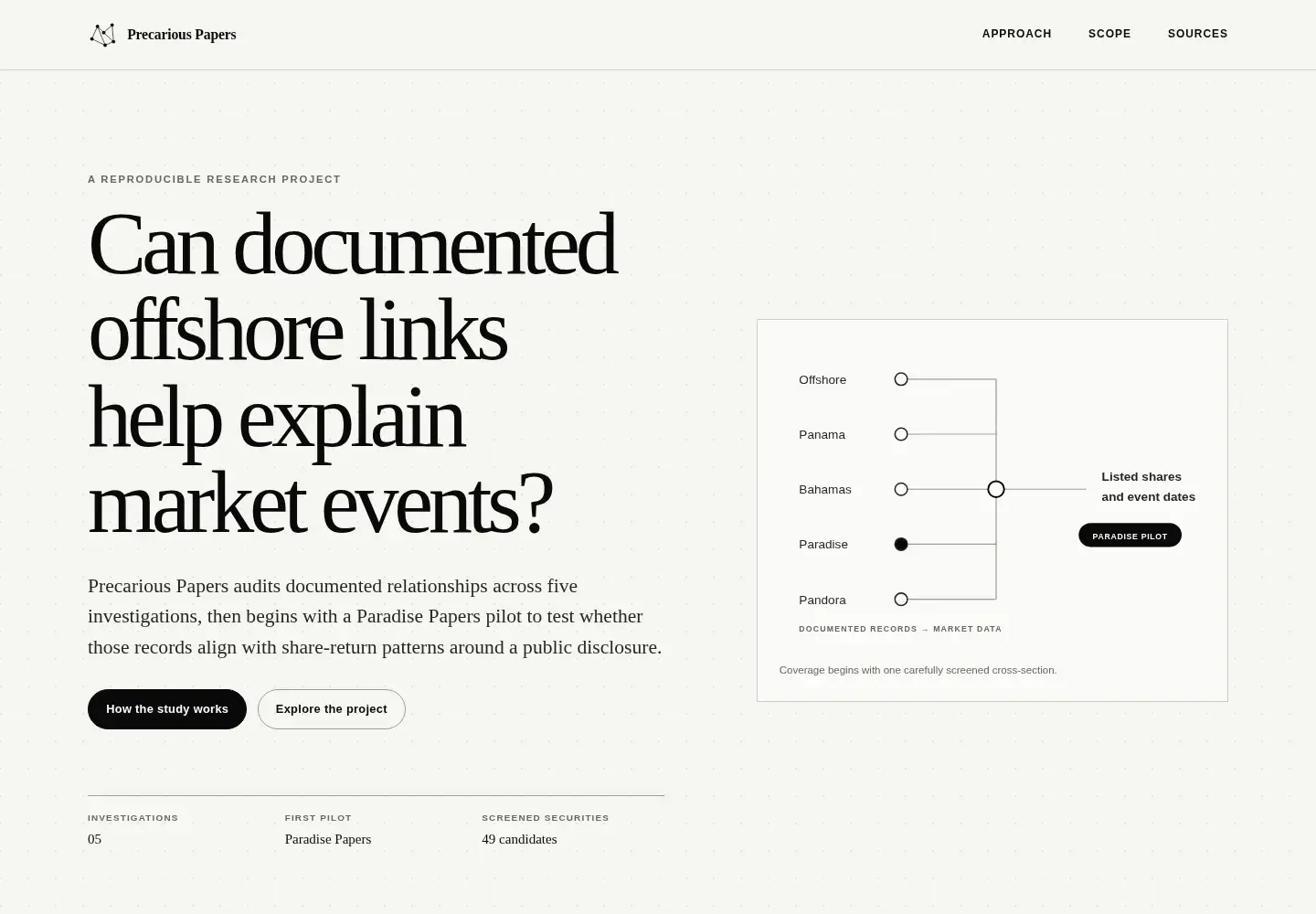
Precarious Papers homepage showing a network diagram connecting offshore investigations to listed shares and event dates.
Website preview · Precarious Papers

Precarious Papers

What happens when hidden financial relationships become public?

An empirical investigation of offshore entities, leaked disclosures, network structure, and market pricing, combining event studies, graph theory, and reproducible analysis.

Methods: Event studies and network econometrics

Python · Jupyter · Econometrics · Graph theory

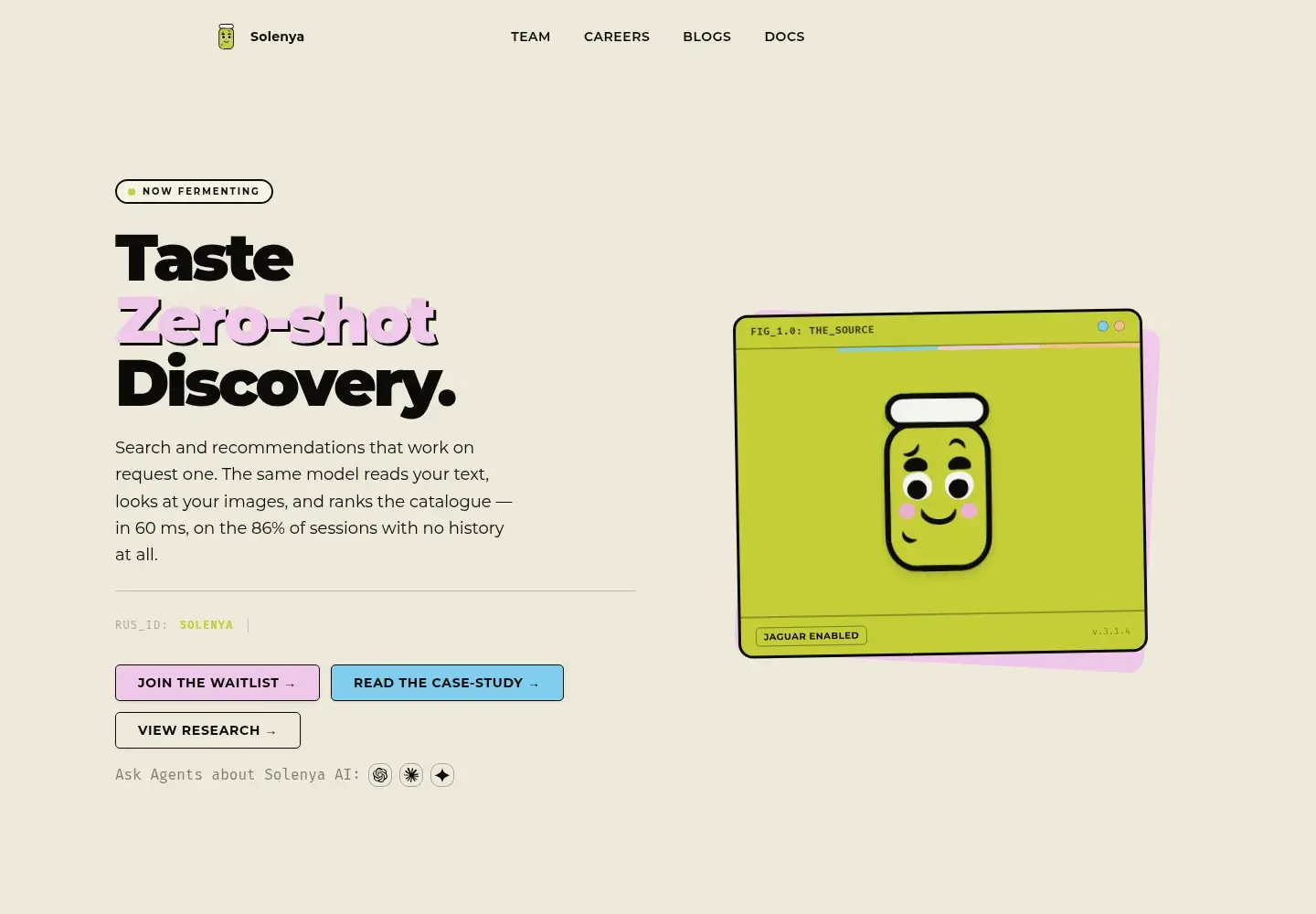
Solenya homepage presenting zero-shot discovery for search and recommendations beside a lime-green product illustration.
Website preview · Solenya · solenya.ai

Solenya

Search and recommendations that work from the first request.

A multimodal discovery platform connecting text and image understanding with product search and recommendations, including for visitors without interaction history.

Multimodal AI · Product discovery · Recommendation systems

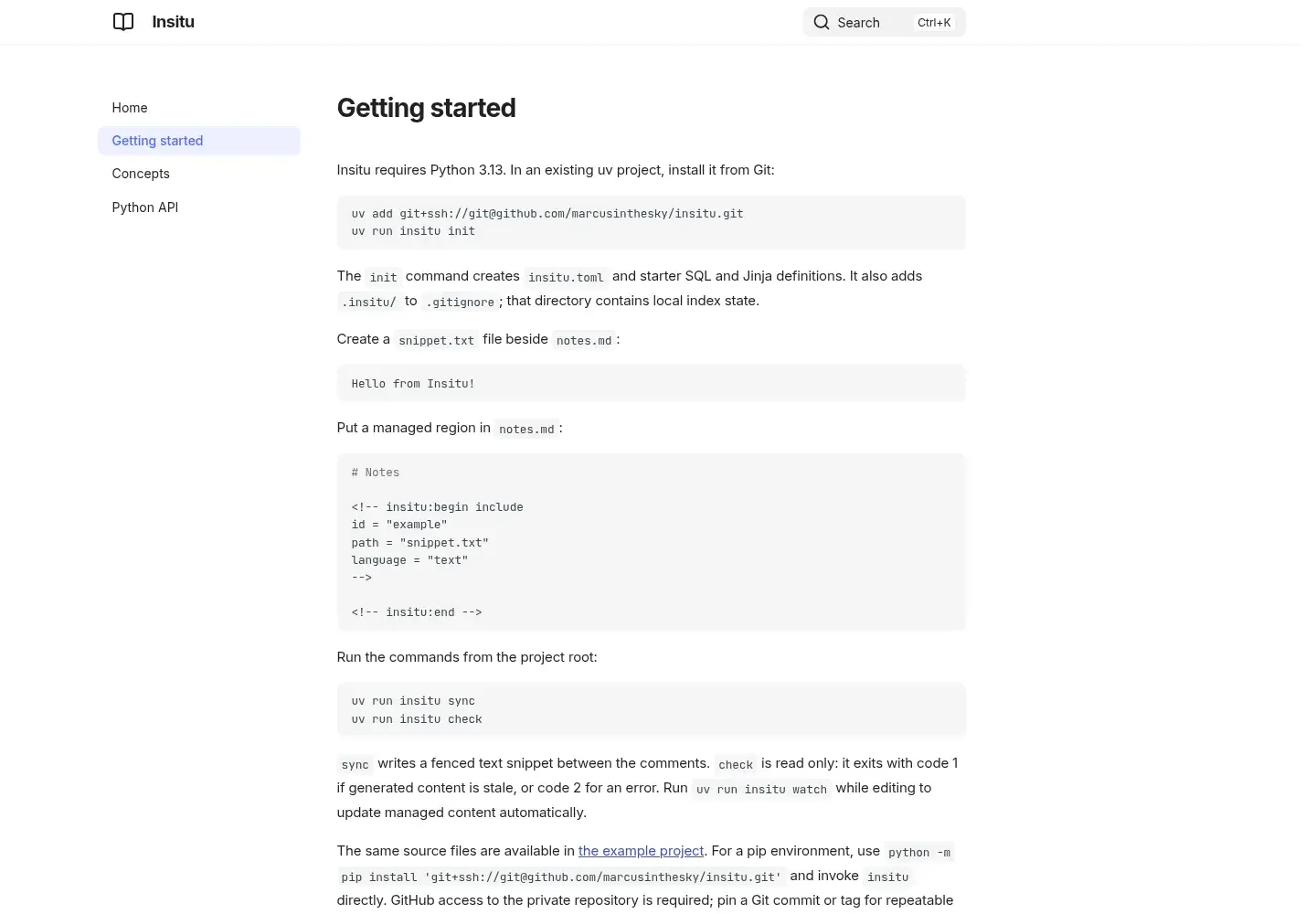
insitu Getting started documentation with example commands and a managed Markdown region.
Website preview · insitu · Getting started

insitu

Keep generated Markdown sections in sync with their source files.

A Python tool that keeps research documents connected to source files, queries and templates, with checks for stale content.

Python · Markdown · Jinja · Zensical

03 /

Research

Questions I am working on

Whether information in language-model representations can be given mathematical structure—and what that structure says about dependence, interaction, and risk.

LotusNelumbo nucifera.
2026Preprint; accepted for World Finance & Banking Symposium, Riga (2026)

Information Games: Strategic Crowding and Firm Repositioning in Language-Model Space

Marcus Gawronsky · Chun-Sung Huang

The question: How does competition change firms' responses to opportunity in language-model space?

arXiv

Ask AI

04 /

Writing

Working notes

The machinery around the research: reproducibility, provenance, modelling choices, and treating analysis as software.

RoseHulthemia. Rosa persica.
Pricing Perspective

No returns: Mega-IPOs and the promise of AI as economic measurement

Mega-IPOs, the convergence of public and private markets, and the case for a new approach to financial measurement.

Pricing Perspective

What are we actually studying when we study AI in finance?

AI in finance plays three distinct roles — a tool for financial practice, a source of economic change, and a means of measurement — and each demands different evidence.

Pricing Perspective

Do language models in finance need a Markowitz moment?

Language models read individual companies remarkably well; the harder question, as Markowitz taught finance, is what that information means together inside a portfolio.